I grew up in a thin-crust family. To me, what makes a pizza delicious is not the crust, but the sauce, cheese, and toppings. The crust has always been merely a substrate – something to hold onto while delivering bites to your mouth. The thinner this substrate, the greater the ratio of ingredients to substrate. Hence – the better pizza. It probably won’t surprise you to hear that I’m a fan of Chicago Deep Dish pizza. But in the absence of that option, I will take thin-crust over thick crust any day.
I’ve encountered alternative philosophies to the thin-crust ways I was born and raised into. A friend told me that, in her view, the reason pizza is delicious is that fundamentally is bread, but with a light smattering of ingredients to zest things up a bit. I have trouble understanding this perspective, but the evolution of pizza over the centuries has led to a fractured society filled with differing opinions. Some of this history is covered nicely by an episode of Max Miller’s “Tasting History”.
Reflecting on my friend’s thin-crust perspective, I thought back to the thick-crust pizzas I have enjoyed the most. As I have said, thick crust is not my style. But I certainly love stuffed crust. Ending the slice of pizza with a cheese-filled tube (rather than what amounts to a bread stick) certainly zhuzhes things up. Taking things a step further, Papa Johns offers a stuffed crust that includes pepperoni.
Why do so many pizzas end in a boring breadstick? And if we have the technology to fill the edge of the pizza with pepperoni and cheese, why can’t we experiment with other more advanced forms of pizza crust? For example, imagine taking the stuffed crust concept further, and deep frying the edge of the pizza crust. This could be accomplished, for instance, by shaping and frying the circle of pizza crust before attaching it to a parbaked disk of dough that would form the base of the pizza. The crisp texture of the edge of the pizza (which amounts to a giant circular mozarella stick) would be a welcome contrast to the soft texture of the center of the pizza.
Speaking of textural contrast – somehow, our society still hasn’t developed a crunchy pizza. Given the degree of fast-food innovation shown by companies like Taco Bell, I don’t understand why the pizza industry lags so far behind (pizza-and-cheese-stuffed-crust notwithstanding). The textural contrast of a crisp crust with the soft sauce, cheese, and toppings could really add excitement to each bite. Given that we landed on the moon over 50 years ago, it’s surprising that crunchy pizza technology is still in a nascent state. So here’s my pitch.
I propose a pizza in which the crust is composed of a giant cheeto. Imagine a giant cheeto in a disk shape, with raised edges. This is the base for your pizza. You cover it with sauce, cheese, and toppings, then bake it. The crust is one homogenous, airy, crisp wafer (not an amalgamation of a large number of small cheetos). The choice of texture (between “original” cheetos and the “cheeto puffs”) is up for debate. I usually favor original cheetos, but a slightly softer texture might be easier to bite into on a pizza. At any rate, the core idea is the same. Create a giant cheeto, and use it as the base for the pizza.
How would you go about creating this? As described in an episode of “Unwrapped”, cheetos are made from a cornmeal batter that is extruded through a proprietary nozzle, then fried. Without the technology to create a true cheeto available, I found a recipe for homemade cheetos from Serious Eats. I rolled it out into a disk, with some trouble. I believe my cheese wasn’t shredded thinly enough.
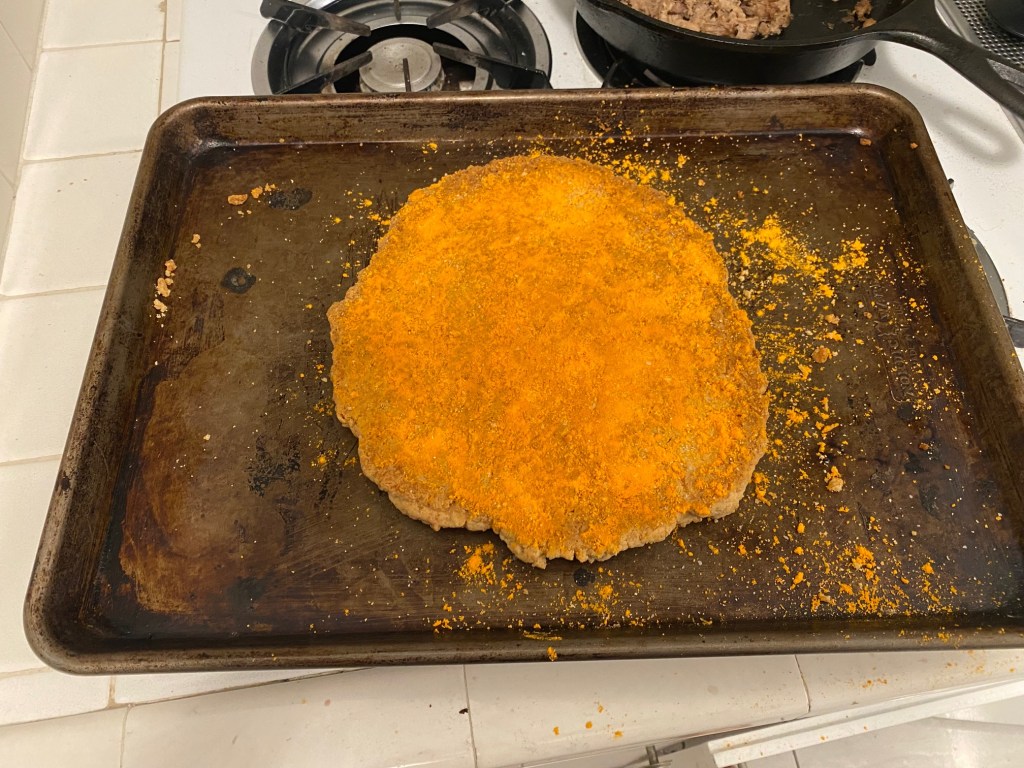
Note that I skipped the instructions for cutting the homemade cheetos into strips, and the baking. I then decorated the unbaked cheeto crust with pizza sauce, toppings, and cheese, and baked it as normal.

I cut into it, and topped it with more of the cheese powder coating from the cheeto recipe.
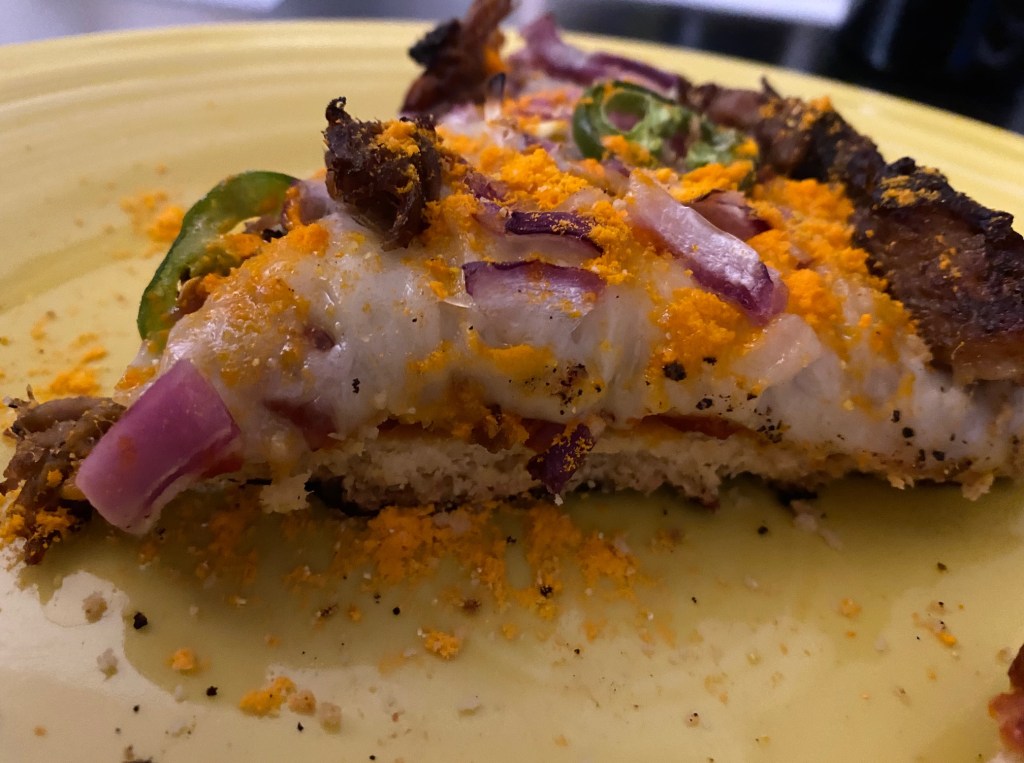
A few things went wrong:
– I added the cheese powder to the crust before baking. The bottom of it burned. I should have added the cheese powder to the top (under the sauce), but not to the bottom. Note that the cheeto recipe recommends adding the powder after baking, which I failed to notice before it was too late.
– The texture of the crust did not remind me of a cheeto at all. It was more like shortbread. I will try following the recipe again before blaming it, but I’m somewhat skeptical that the light and airy texture of a cheeto can be obtained with this recipe.
On the bright side, the crisp, crumbly, shortbread texture of the crust was quite pleasant. But I think a giant cheeto could be even better.
How to proceed with further experimentation? I have a few ideas:
– Extruding a cornmeal batter through a whipped cream maker might produce a light, aerated batter. I have not tried this, and I do have my doubts. But using a whipped cream maker in some way to aerate the batter could work.
– An excellent recipe for fried fish appears in Samin Nosrat’s Salt,Fat, Acid, Heat. It recommends using beer and vodka as the liquids. The carbonation of the beer, and the low boiling point of the alcohol, help create a delicate, airy fried crust around the fish. Similar techniques of making a cheeto batter and frying it might give good results. (As an aside, I also think a funnel cake could make an excellent pizza crust. This wouldn’t require as much research, and would almost certainly be delicious).
While enjoying a cocktail at the Onyx rooftop bar in Santa Monica, I met a tax accountant who struck up a conversation with me. He told me about his love for hosting exquisite dinner parties. Naturally, our conversation drifted to my theories on the cheeto crust pizza. He gave me a few suggestions. I have not tried them yet, but they may serve as inspiration.
– Perhaps there’s a way to make something along the lines of a standard dough that is somehow aerated with egg whites.
– Try making something like a tempura batter, with egg whites and club soda.
– Consider pan frying the crust in butter, similar to a dutch baby.
– You might want to put ingredients in cheese, meat, sauce order. (I don’t remember the reason for this recommendation but it intrigues me.)
– Consider putting an airy dough or batter in an oven or dehydrator for a few hours, then use a frier or air frier to further crisp it.
So there it is – the Cheeto Crust Pizza Theory. Until I can convince Pizza Hut and Frito-Lay to team up, the best we can do is attempt to make it ourselves. This sort of partnership doesn’t sound too crazy, considering innovations like the Doritos Locos Taco. But until such partnership exists – back to the lab.

 mchorton's blog
Leave a comment